
Choose a payment stack, not a single winner
For most first-time visitors, a sensible starting point is one prepared mobile wallet, one physical bank card and some RMB cash. Alipay and Weixin Pay are widely used for everyday merchant payments, but no app, card or acceptance route should be your only plan.
Some visitors may also be able to use a supported home-country wallet through a cross-border network. Availability depends on the wallet and market, so check the current provider list rather than assuming that an app works everywhere.
Compare the main payment methods
Swipe the table horizontally to compare every column.
| Method | Best use | Prepare before travel | Main limitation |
|---|---|---|---|
| Alipay | Everyday merchant purchases and a travel-focused app experience. | Create an account, add an eligible card and complete the checks shown in the app. | Account, card, merchant and issuing-bank decisions can still block a payment. |
| Weixin Pay inside WeChat | Merchant checkout and services reached through the WeChat ecosystem. | Make sure you can access your account, then add an eligible card if the option is available. | Menus, verification and supported scenarios can vary by account and app version. |
| Physical bank card | Hotels, larger merchants and a backup outside the wallet. | Carry the card, know its PIN and keep access to the issuer's security approval route. | Direct card acceptance is not consistent at every small merchant. |
| RMB cash | Phone, data, wallet or card failures and staffed offline purchases. | Obtain a practical amount and keep smaller notes where possible. | Cash cannot replace app-only ordering, booking or transport flows. |
Prepare before departure
- Choose Alipay or Weixin Pay as your first mobile payment route.
- Register with a phone number you can still access while traveling.
- Add an eligible international card and complete any identity or card checks shown in the app.
- Confirm that your issuing bank can approve overseas and digital-wallet transactions.
- Keep a physical card and RMB cash separate from your phone.
- Arrange mobile data and save your bank's support route offline.
Installation alone is not readiness. You should be able to sign in, find the payment area and receive any security messages your account or bank requires. Make your first small purchase in a low-pressure setting after arrival rather than discovering the workflow in a taxi queue.
Open the guide for the task in front of you
Set up Alipay
Use the dedicated guide for account preparation, adding an eligible international card, merchant purchases and Alipay-specific failures.
Set up Weixin Pay
Use the WeChat guide for naming, account access, card linking, merchant checkout and recovery steps.
QR payment has two common checkout flows
At some counters, you scan the merchant's collection code inside your payment wallet and confirm the amount. At others, you open your payment code and the cashier scans it. A menu, login, transit or personal-transfer QR can look similar but does a different job.
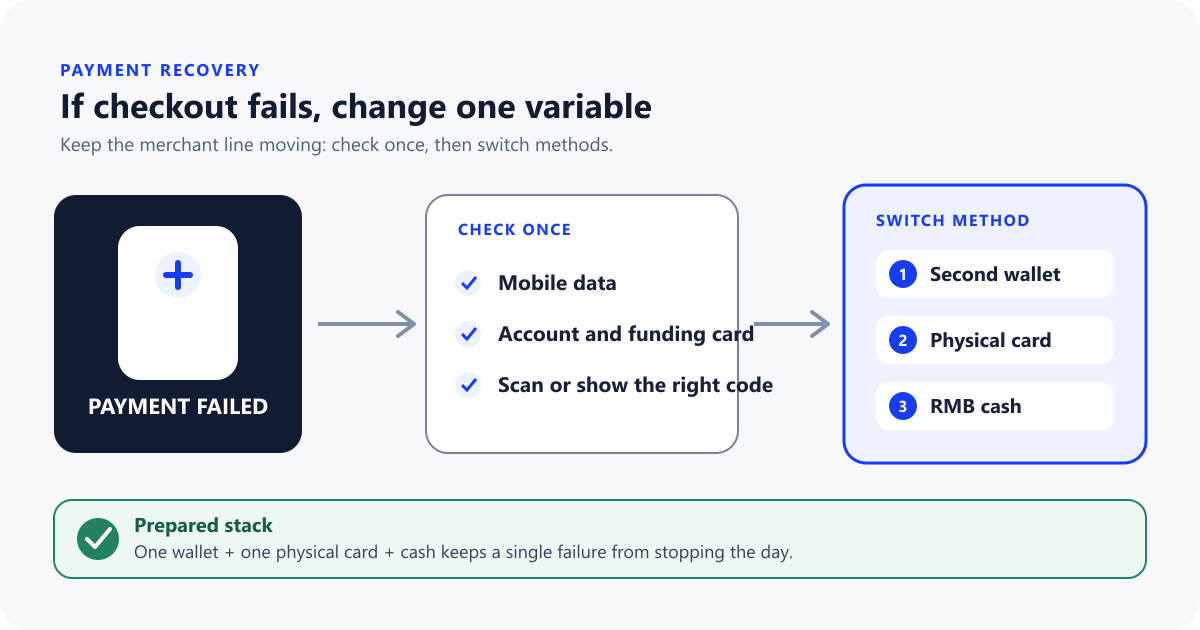
If a payment fails, change one variable
Step out of the line and check the simple dependencies: data connection, account access, the selected funding card and whether the cashier expects you to scan or show a code. If the wallet or bank declines the payment, switch to your second wallet, physical card or RMB cash instead of repeating the same attempt.
Paying in China: common questions
Can a foreign visitor use mobile payment in China?
Yes. Official guidance says eligible overseas visitors can register for supported mobile payment services and add eligible international cards. The live app and your issuing bank decide what is available for your account.
Should I choose Alipay or WeChat Pay?
Choose the app you can set up and navigate confidently, then add the other if practical. Alipay is a focused starting point for many visitors; Weixin Pay is useful if you already rely on WeChat or its mini-program ecosystem.
Can I rely only on a foreign credit card?
No single method is dependable at every merchant. Keep a physical card, but also prepare a mobile method and RMB cash.
Does China still accept cash?
Cash remains an official payment option. It is valuable as a fallback, although it cannot complete app-only transactions.
Where are the merchant setup instructions?
This site covers consumer travel payments only. It does not advise businesses on payment processors, APIs or accepting wallet payments.