
Alcohol sales age & public drinking
Buying alcohol: 18+. Alcohol cannot be sold to under-18s. Sellers must ask for ID when a buyer’s age is unclear.
This sales restriction is different from a blanket minimum drinking age. Separate protections still apply: parents and guardians must not allow or encourage minors to drink, and bars must not admit minors.
Can you drink beer on the street in China?
For adults, outdoor drinking is often relaxed in practice, especially with food at street-side restaurants and night markets. A quiet beer in these settings is a familiar part of local nightlife. Qingdao’s old-town beer festival even promotes a walking route with beer stops.
Check the setting and follow local rules, posted signs and venue instructions. National law prohibits anyone from drinking in schools, kindergartens and other public places used for minors’ group activities. That specific restriction should not be read as a ban on every street or park where a child happens to be present.
Keep it moderate. Stay in control.
Alcohol carries health risks even if you do not feel drunk. If you choose to drink, avoid heavy drinking, keep noise down and do not disturb other people. Being drunk does not excuse a public-order offence. Never drink and drive.
Do you tip in China?
Tipping is generally not expected in most restaurants and hotels. An extra tip is usually unnecessary and may cause confusion. Pay the displayed price and check the bill for any service charge.
Organized tours and some international services can have their own arrangements; ask what is included when booking.
ADHD medicines, codeine & prescriptions
Check the active ingredient, dose and quantity before you travel. Pay particular attention to amphetamine-based ADHD medicines, methylphenidate (such as Ritalin) and codeine-containing medicines.
Controlled does not automatically mean prohibited. Chinese regulations provide a framework for carrying certain controlled medicines for personal medical use, with documentation and quantity limits. A prescription alone is not a universal clearance for every ingredient or supply.
- Ask Chinese Customs or your Chinese embassy about the exact medicine and quantity.
- Carry original packaging, your prescription and a medical diagnosis letter.
- Confirm any certificate or declaration required before departure.
- Do not interrupt a prescribed treatment without discussing travel arrangements with your clinician.
Cannabis, THC, CBD & drug testing
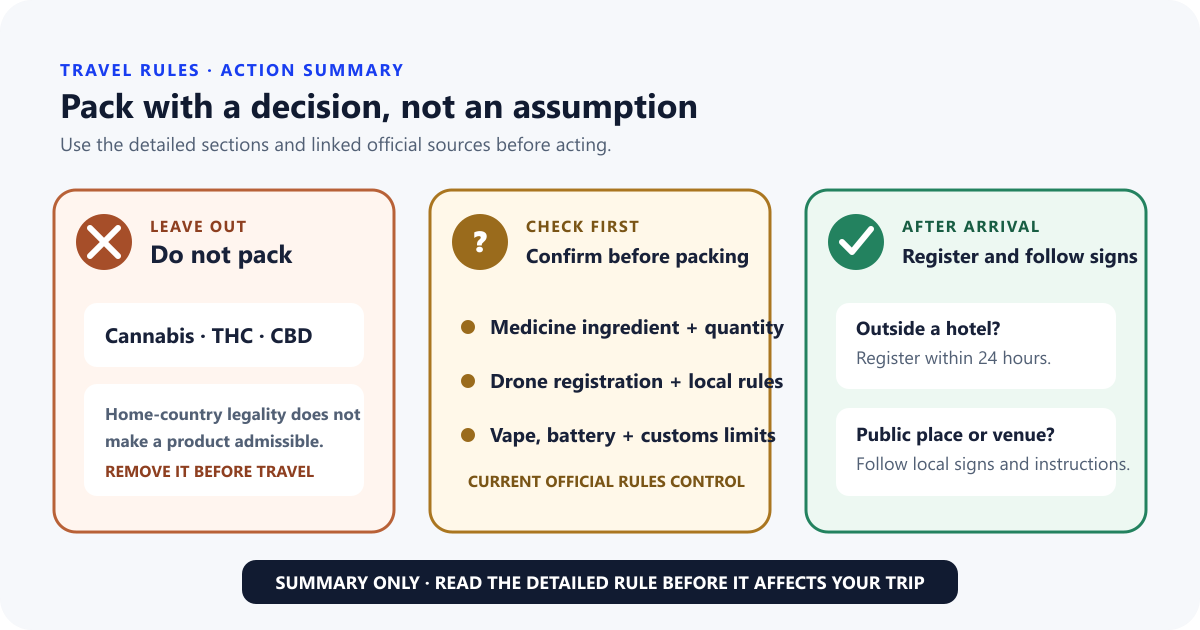
Do not bring cannabis, THC or CBD products into China. This includes oils, gummies and vape liquids. A product being legal in your home country does not make it admissible in China.
Authorities may test foreign nationals for drugs, including on entry. A positive result may lead to prosecution, detention or deportation even if the substance was taken outside China. Drug offences carry severe penalties.
Bringing a drone to China
Do not assume a drone below 250 g is exempt. Current national rules require civil drone owners to register. Check registration, airspace and flight-approval requirements before operating any drone.
Beijing has stricter rules
Since 1 May 2026, Beijing’s entire administrative area has been controlled airspace and all outdoor drone flights require approval. Beijing’s official visitor notice also says travelers must not transport or carry drones or core components into the city, including while transiting through Beijing.
A revised Beijing regulation takes effect on 15 November 2026. It expressly prohibits drone flight, possession or storage, and bringing drones or core components into Beijing, except for narrow approved special-support uses. Check the current rule before packing a drone for any Beijing itinerary.
Vaping & flavored e-cigarettes
Sales of e-cigarettes in flavours other than tobacco are prohibited. This is a sales restriction; it should not be read as a claim that every vape or every instance of possession is banned.
Follow local smoking and vaping restrictions, airline battery rules and customs limits. Do not assume that vaping is allowed where smoking is prohibited.
Foreign passports & hotel check-in
Ask your hotel to confirm that its front desk can register your passport before arrival. Hotels must not refuse foreign guests solely because they claim to lack a foreign-guest licence.
If check-in fails, ask the duty manager to contact local police for registration assistance, and contact the booking platform. 12345 is a non-emergency government-services line. Use 110 for police emergencies.
Staying with friends or outside a hotel?
You or your host must register your accommodation with local police within 24 hours. Hotels handle their guests’ registration. Online options depend on your location; do not assume an online service works everywhere.